
Written by Tina | Reviewed by Mauve, Last Updated Date on August 19, 2026
Is there dirt in your dog’s ears? Is there an unpleasant odor? Many owners believe that simply wiping away dirt from their dog’s ears is sufficient and that it doesn’t require serious attention. However, that seemingly unremarkable dirt can actually trigger more severe health problems. Conditions such as ear infections, ear mites, and otitis require your utmost attention!
Why is dog ear health important? Dog Ear Infections: What You Need to Know.
Dog Ear Infections Are Very Common!
Ear infections in dogs can be caused by factors such as their environment, the unique structure of their ear canals, improper cleaning habits, and physical allergies. Ear infections are among the most common ailments in dogs and a frequent concern for pet owners.
As a pet parent, understanding the facts about dog ear infections is the first step in protecting your pet’s health. Due to the unique “L-shaped” anatomy of a dog’s ear canal (consisting of a vertical and a horizontal section), moisture and debris accumulate more easily than in human ears, leading to a high incidence of ear infections.
“There’s some dirt in my dog’s ears—just wiping it clean with a wet wipe should be fine, right? No need to make a big deal out of it.” — To be honest, that’s exactly what I thought when I first got a dog years ago.
Dog breeds prone to ear infections
- Poodles
- Cocker Spaniels
- Golden Retrievers
- Labradors
- Basset Hounds
- German Shepherds

According to the AVMA and publicly available research data, there is no single “breed with the highest incidence” of ear infections; however, high-risk breeds include Cocker Spaniels, Poodles, and German Shepherds. Notably, a large-scale study indicated that Basset Hounds face the highest risk of otitis externa, with a prevalence rate of approximately 28.81%.
To learn why Poodles are prone to ear infections, you can read this article: “Why Are Poodles Prone to Ear Infections? Causes, Symptoms, and Prevention.”
Types of Conditions Caused by Dog Ear Infections
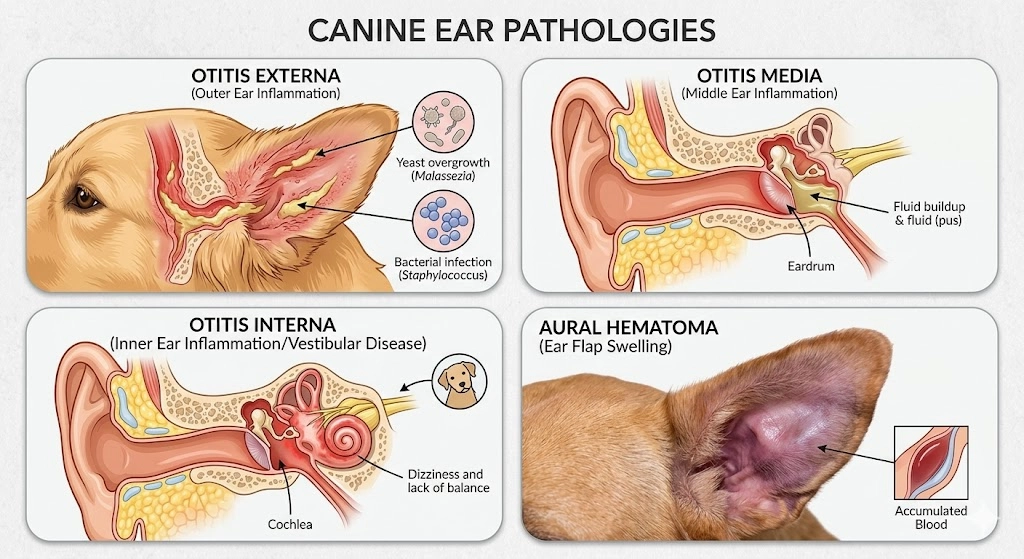
The most common types of inflammation in dog ear infections are otitis externa, otitis media, otitis interna, and aural hematoma.
Having established the prevalence of ear infections, we must first clarify a critical—and dangerous—misconception: many owners assume that if a dog’s ears look slightly red or smell a bit, the issue will resolve on its own if left alone. But is that really the case?
I learned this the hard way when my dog spent several days frantically shaking his head and scratching his ears, even refusing to let me touch his head. When I finally took him to the vet, the doctor shook his head and told me it wasn’t just a case of “dirty ears,” but a severe yeast infection in the ear canal that was on the verge of spreading to the middle ear. That episode cost $500 to treat, and my dog, Leo, had to endure two weeks of suffering.
In veterinary clinical practice, ear infections are among the most painful conditions dogs experience—yet they are also highly treatable. However, failing to seek timely treatment can lead to complications and more severe ear health issues. Depending on the location of the infection, veterinarians generally classify ear infections into three types:
1. Otitis Externa(outer ear infection)
Otitis externa refers to inflammation in the area of the external ear canal—extending from the ear flap (pinna) to the eardrum—and is the most common ear disease in dogs.
According to the AVMA, is an inflammation of the tissue lining the ear canal and surrounding structures, outer ear infection often accompanied by secondary bacterial or yeast colonization. The Merck Veterinary Manual notes that otitis media and otitis interna are often associated with persistent otitis externa , the spread of infection, or other underlying conditions; thus, ear problems are rarely “single-point failures” but rather a progressively worsening process. Therefore, particular attention must be paid to otitis externa in dogs!
Primary affected areas: Ear flap (pinna), vertical ear canal, horizontal ear canal.
Predisposing factors: Food or environmental allergies, ear mite infestations, yeast infections, bacterial infections, untreated moisture in the ear canal after swimming or bathing, excessive ear hair.
Common symptoms: Frequent head shaking, scratching at the ears, noticeable ear odor, redness of the ear canal, increased brown or yellow discharge, pain upon touching the ears.
2. Otitis Media (middle ear infection)
Otitis media refers to a condition where the infection has breached the eardrum (tympanic membrane) and entered the middle ear cavity. When middle ear infection leads to erosion or perforation of the eardrum, infectious agents can spread directly into the middle ear cavity through the perforation; otitis media represents a more severe stage of infection. Because the facial nerve passes through the middle ear region, the infection can affect nerve function. Otitis media is more common in adult and senior dogs.
Infection progression: outer ear infection→ Eardrum damage → Bacteria/infectious agents enter middle ear → Otitis media.
Common symptoms: Pain when opening the mouth, difficulty chewing, hearing loss, head and neck pain, facial nerve paralysis.
Note: Owners often overlook the otitis media stage because the appearance of the ear canal improves and discharge decreases, even though the infection has actually penetrated deeper into the ear. Consequently, veterinarians typically recommend further evaluation—such as otoscopy, X-rays, CT scans, or MRI—for cases of ear infection that recur over a period exceeding three months.
3.Otitis Interna (inner ear i nfection)
Otitis interna is a deeper ear infection involving the structures of the inner ear; while relatively rare, it has the most significant impact on balance and the nervous system. Otitis interna is usually the result of worsening otitis media, where infectious and inflammatory agents invade inner ear structures via the inner ear windows or bony channels, often accompanied by distinct neurological symptoms.
The Merck Veterinary Manual explicitly states that otitis interna can lead to balance disorders and hearing loss, and some nerve damage may persist even after the infection has been cured.
Affected areas: Cochlea, vestibular system, auditory nerve.
Common symptoms: Persistent head tilt, unsteady gait, circling, leaning to one side, loss of balance.
Inner ear infections pose the most serious health risks to dogs. If left uncontrolled, the inflammation can breach anatomical barriers and spread intracranially, triggering life-threatening neurological conditions such as meningitis, meningoencephalitis, or brain abscesses.
4. Specific Complication: aural hematoma
The intense itching and pain caused by ear infections drive dogs to shake their heads vigorously or scratch their ears. This violent physical impact can easily rupture the dense network of capillaries within the ear flap (pinna), causing blood to pool between the skin and cartilage and form an aural hematoma. Blood accumulates rapidly in this space, causing the normally thin ear to swell instantly into a massive, fluid-filled sac resembling a hot-air balloon.
An aural hematoma cannot be resolved with medication alone; surgical intervention is required. The procedure involves incising the skin, draining the accumulated blood, and applying extensive grid-like sutures. Without this treatment, the ear flap may undergo fibrosis and shrivel, resulting in a deformed “cauliflower ear.”
Can hydrogen peroxide be used for dog ear infections?
This is absolutely not allowed and must be strictly avoided.
Instead of visiting a veterinarian, many owners turn to common household items. However, for a dog’s inflamed ear canal, a seemingly mild disinfectant like hydrogen peroxide can cause damage akin to a chemical burn. Many owners attempt to flush inflamed ears with household hydrogen peroxide or alcohol, believing it will kill bacteria.
Similarly, alcohol should never be introduced into a dog’s ear, as it will exacerbate inflammation and infection. The strong oxidizing properties of hydrogen peroxide and the nature of alcohol can irritate or even burn inflamed ear canal tissue, disrupt the normal microbial flora, and potentially create an environment that fosters bacterial proliferation. It is best to use pet ear drops designed for dogs for regular cleaning.
The American Veterinary Medical Association and various clinical toxicology guidelines (such as the ASPCA Animal Poison Control) note that while 3% hydrogen peroxide can serve as an oral emetic (to induce vomiting) under veterinary guidance following the ingestion of toxins, it is strictly forbidden to pour it directly into a dog’s ear canal due to its highly irritating nature on mucous membranes and inflamed tissue.
Hydrogen peroxide is intended for inducing vomiting, not for treating ear conditions! For routine ear care, the correct approach is to use veterinarian-recommended ear drops or professional ear cleaning solutions.
Usually, when I clean Leo’s ears, I use pet wipes or gloves to do it. It’s convenient and fast!
Can a dog’s ear infection heal on its own without Vet?
The answer is no.
In most cases, ear infections—whether caused by bacteria, yeast, or ear mites—will not resolve on their own. Because the risks of waiting for spontaneous recovery are so high, it is crucial to learn how to recognize the early signs of infection. Often, what appears to be merely “a bit of dirt” is actually an early symptom requiring intervention.
Without intervention, the source of the infection persists; failure to clean a moist ear canal fosters bacterial growth and yeast proliferation, while underlying issues like allergies remain unaddressed.
Therefore, it is important not to overlook ear problems in dogs.
Owners should learn to distinguish between symptoms of ear mites, yeast infections, and other issues to ensure appropriate treatment and establish good ear cleaning and care habits. Restoring ear health and treating severe infections typically requires veterinary care and prescription medication.
If you are unsure about the frequency of ear cleaning, please refer to this article: “How Often Should You Clean Your Dog’s Ears? A Complete Guide to At-Home Ear Care.”
When to See a Vet?
Even with routine care and prevention, certain ear problems can deteriorate rapidly. Recognizing the warning signs of an emergency helps owners seek professional veterinary help promptly, preventing more serious consequences.
- Persistent head tilt
- Loss of balance or unsteady gait
- Circling in place or falling over
- Rapid involuntary eye movement
- Obvious pain (flinching or vocalizing when the ear is touched)
- Severe ear swelling or bleeding
- Copious yellow-green purulent discharge
- Sudden, significant hearing loss
Veterinary Disclaimer
The content of this article is for general pet care and educational purposes only and is not a substitute for professional veterinary diagnosis, treatment, or personalized advice.
Canine ear infections can be caused by bacteria, yeast, ear mites, allergies, foreign bodies, or other health issues; a definitive diagnosis requires an examination by a licensed veterinarian. Please consult a veterinarian promptly if your dog exhibits ear pain, foul odor, discharge, head tilting, or persistent symptoms.
1.How often should a Poodle’s ears be cleaned?
In healthy conditions, preventive cleaning once or twice a week is sufficient. Over-cleaning (such as daily washing) can disrupt the ear canal’s bacterial balance and actually increase the risk of infection.
2.What should be done if the ears have become red and smelly?
Stop cleaning when there is inflammation! If you notice redness, swelling, bad odor, or if the ear recoils when touched, it indicates an infection. The correct approach is to seek medical attention immediately and have a veterinarian prescribe medication for treatment.
3.Should we remove the ear hair when cleaning the ears?
You can simply remove the visible ear hair on the surface, or use a small pair of scissors to trim the long hair that has come out. Just ensure that the ear canal is ventilated. Forcefully pulling out the hair can damage the hair follicles and disrupt the skin barrier of the ear canal, which will actually make it more likely to cause an infection.
-
Sale!

disposable Finger-shaped dental cleaning wipes for pets fresh breath
Original price was: $6.68.$3.34Current price is: $3.34. Add to cart -
Sale!

Gentle Neutral pH Round Pet Eye Wipes Tear Stain Removal
Original price was: $5.98.$2.99Current price is: $2.99. Add to cart -
Sale!
Foaming dog body cleaner with a silicone brush for pet paws no rinsing
Original price was: $8.98.$4.49Current price is: $4.49. Add to cart