
When you notice your little cat has a big clump of matted fur, don’t panic and reach for the clippers just yet. My cat has dealt with this too, especially around the ears and armpits, where small mats can easily hide if you don’t check regularly.
Today, I want to share how I use a dematting brush for cats to gently work through matted fur. Hopefully, these little tips will make everyday cat grooming a bit easier for you and your furry friend.

1. What Tools Do You Need for Dematting Cat Hair?
There are actually quite a few grooming tools you can use, including a deshedding brush, dematting rake, pin brush, comb, and cat dematting tool. When I first started keeping a cat, I thought having so many brushes was a little overwhelming, but I eventually realized that each one has its own job.
What’s the Difference Between a Dematting Brush for Cats, Dematting Rake, and Slicker Brush for Cats?
After living with a cat for a while, I’ve learned that you really can’t use the same brush for everything. Choosing the right tool based on how tangled the fur is can make the whole process much easier and less stressful for your cat.
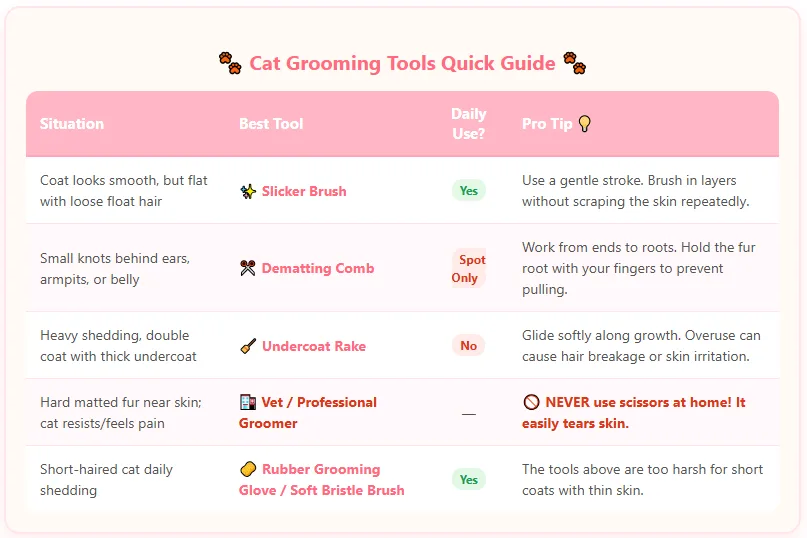
If your cat just has a lot of loose fur, a slicker brush for cats can be enough for a gentle pass. For small mats around areas like the ears and armpits, I use a dematting brush for cats, starting from the ends of the fur and slowly working toward the roots. Don’t pull hard.
During shedding season, when the undercoat gets especially thick, a dematting rake for cats can be useful for getting through the loose fur underneath.
❤ Tip:
If the mat is already hard, tight, and stuck close to the skin, don’t try to cut it out with scissors yourself! It’s very easy to accidentally cut your cat’s skin. In that situation, it’s much safer to let a professional groomer or veterinarian handle it.
Short-haired cats are much easier to manage. A rubber grooming glove and a soft brush are usually more than enough for regular grooming.
2. How to Use a Dematting Brush for Cats?
① First, check where the mat is and how severe it is.
If it’s a small mat in a sensitive area like behind the ears or around the armpits, I gently test it with a cat dematting tool, moving slowly in the direction the fur grows. I never try to yank the hair out.
② If the mat is a little tighter, gently loosen it with the brush before slowly working through it. When I’m brushing, I sometimes gently massage around the area too. It almost feels like giving my cat a little fur massage.
③ Once the mat is loosened, use a soft brush to gently smooth the surrounding fur in the direction it grows. This also helps remove any loose hair left behind.
④ Then, clean up the loose hair you’ve removed, especially around the rear and tail, where fur can easily tangle again.
⑤ Finally, I like to wipe my cat’s coat with a pet-safe wet wipe to finish up the grooming routine.
3. What Can You Put on a Cat’s Matted Fur?
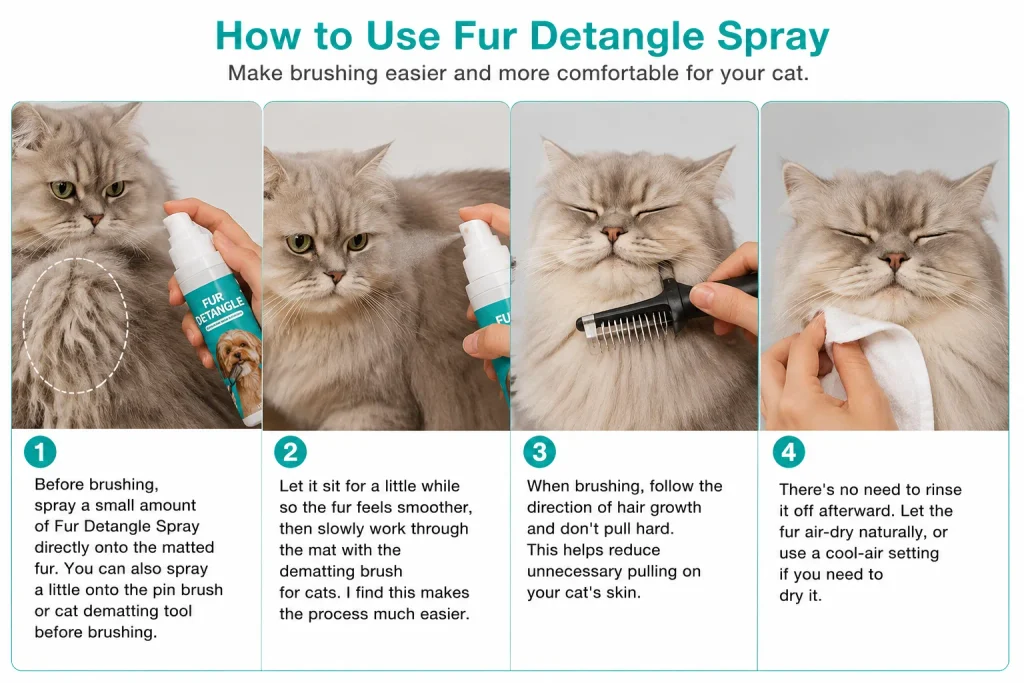
If it’s just a small, mild mat, I like to use a cat-specific detangling spray along with the brush. It can make the fur a little easier to work through. You don’t need to spray a lot—just a small amount around the matted area is enough.
● Before brushing, spray a small amount of cat dematting spray directly onto the matted fur. You can also spray a little onto the pin brush or cat dematting tool before brushing.
● Let it sit for a little while so the fur feels smoother, then slowly work through the mat with the dematting brush for cats. I find this makes the process much easier.
● When brushing, follow the direction of hair growth and don’t pull hard. This helps reduce unnecessary pulling on your cat’s skin.
● There’s no need to rinse it off afterward. Let the fur air-dry naturally, or use a cool-air setting if you need to dry it.
4. How Do You Get Rid of Severely Matted Cat Hair?
For severe mats, it’s better to have them handled professionally. Don’t try to brush, cut, or trim them yourself at home with scissors.
VCA Animal Hospitals also advises against trying to forcefully brush out severe mats that have become felted or form hard clumps close to the skin. In these cases, it’s best to contact a professional groomer or veterinarian. They may use clippers to remove the matted fur and, if necessary, sedation may be considered. They can also check whether the skin underneath has been irritated or injured.
5. Frequently Asked Questions
Do Dematting Brushes Work for Cats?
Yes, but I think it really depends on how severe the mat is. If your cat only has a few small mats, a dematting brush for cats can be really helpful. With a few gentle passes, you can slowly work loose, tangled fur apart.
Can I Brush Out Matted Cat Hair?
Yes, but not every mat should be brushed out directly. If it’s a small, newly formed mat, you can usually work through it slowly.
If the mat is close to the skin, covers a larger area, or your cat clearly resists when you touch it, I wouldn’t keep brushing. Forcing the mat apart can hurt your cat, and in more severe cases, it’s better to have a professional take care of it.
Can Cats Get Rid of Their Own Matted Fur?
Cats do groom themselves, but licking is mainly part of their normal cleaning routine and isn’t enough to remove fur that’s already tightly tangled into a mat.
If I notice an obvious mat, I prefer to help my cat deal with it. Regular brushing is also important, especially around the back, legs, and the back part of the body—areas that cats have a harder time reaching themselves and where mats can quietly build up.
Is a Matted Cat Neglect?
Not necessarily. I really don’t think you should feel like you’re a bad cat parent just because you find a mat on your cat.
To me, having a cat doesn’t mean keeping every single strand of fur perfectly groomed every day. What matters is noticing the problem and taking care of it when you find it. Keeping small mats under control and helping your cat get used to regular brushing can make grooming much easier over time.
-
Sale!
-1-300x300.webp)
Cat Chin Blackhead Cleaning Wipes for Cats
Original price was: $11.89.$9.99Current price is: $9.99. Add to cart -
Sale!
Pet Wipes Cat Dog Circle Wipes for Cleaning Eyes
Original price was: $6.99.$2.99Current price is: $2.99. Read more -
Sale!
Pet Dental Finger Wipes Pouch – Fresh Breath for Dogs amp Cats
Original price was: $4.78.$2.39Current price is: $2.39. Add to cart