

Dogs are our long-term companions and cherished members of our families; however, many owners often overlook issues regarding their dogs’ ears. According to research by the American National Center for Biotechnology Information, the prevalence of ear mites in dogs ranges from approximately 2.8% to 6% across different regions. Although less common in dogs than in cats, ear mites appear more frequently in puppies, multi-pet households, and animals that have had contact with strays. How to choose the best ear mite medicine for your dog?
This article will provide a detailed explanation of ear mite symptoms, recommended medications, home treatment methods using ear drops, and safety precautions to help keep your beloved pet free from the distress caused by ear mites. The content of this article is for educational and informational purposes only and should not replace professional veterinary diagnosis and treatment. Therefore, please consult a qualified veterinarian before administering any medication or treatment to your pet.
Ear Mites (Otodectes cynotis): These are microscopic organisms that parasitize the external ear canals of dogs and cats. Measuring approximately 0.3 to 0.5 millimeters, they are nearly impossible to distinguish with the naked eye, though occasionally, one may spot tiny moving white dots. These mites enter a dog’s ears and feed on earwax and skin debris, triggering a cascade of reactions that manifest as severe itching, redness, swelling, and inflammation of the ear canal.
They can be transmitted through direct physical contact between animals or indirectly via contaminated objects and environments.
According to veterinary parasitology resources from the University of Saskatchewan in Canada, ear mites are highly contagious. Therefore, households with multiple pets must pay particular attention to isolation measures and environmental hygiene to prevent the spread of infestation. Ear mites can survive for a short period of time in the environment, waiting to locate a host upon which to subsist; adult mites have a lifespan of approximately two months. The specific modes of transmission are as follows:
Playing with other pets, or with stray cats and dogs, involves mutual grooming (licking).
New pets are arriving with a pre-existing ear mite infestation—this is particularly common in puppies and kittens, as young animals are highly susceptible to ear mite outbreaks.
Multi-pet households: If one pet becomes infected, the infection can easily spread to other pets in the home.
Shared Items: Combs, bedding, sofas, pet clothing, toys, doghouses, and beds.
Gathering Places: Parks (grassy areas), pet shops, grooming shops, and boarding shops.
Ear mites thrive in warm, humid, and dirty ear canals. Although ear mites rely primarily on a host’s ear canal for survival, environmental factors—specifically high humidity and poor hygiene—can allow them to survive for longer periods outside a host, thereby increasing the risk of infection.
Dogs typically do not exhibit strange behaviors without a reason. If a dog is infected with ear mites, the following symptoms will usually be observed:
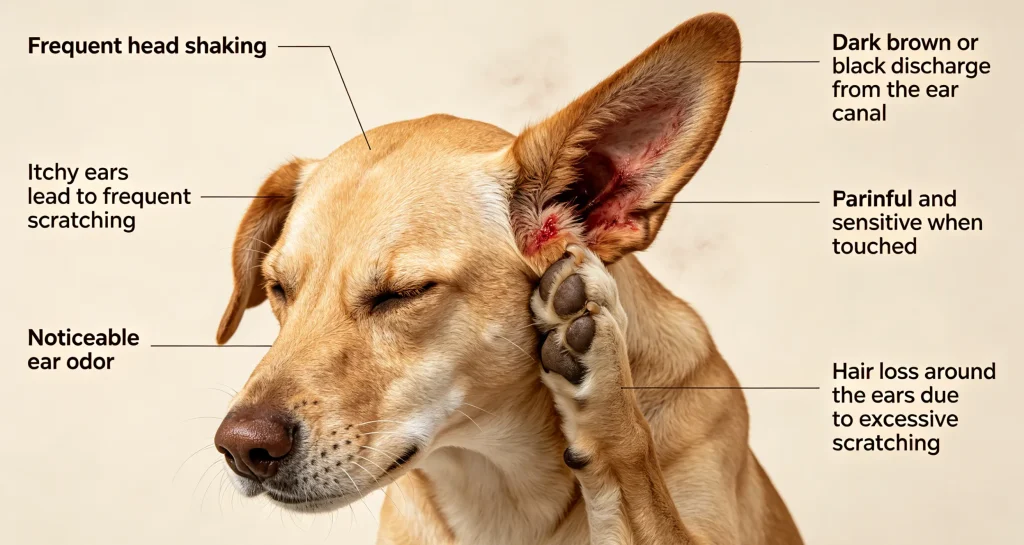
Typical clinical signs include black earwax, redness, swelling, and pain in the external ear canal. In severe cases, secondary bacterial or yeast infections may develop; if such severe conditions arise, it is strongly recommended that you seek veterinary treatment immediately!
Strictly speaking, no single medication is suitable for every dog.
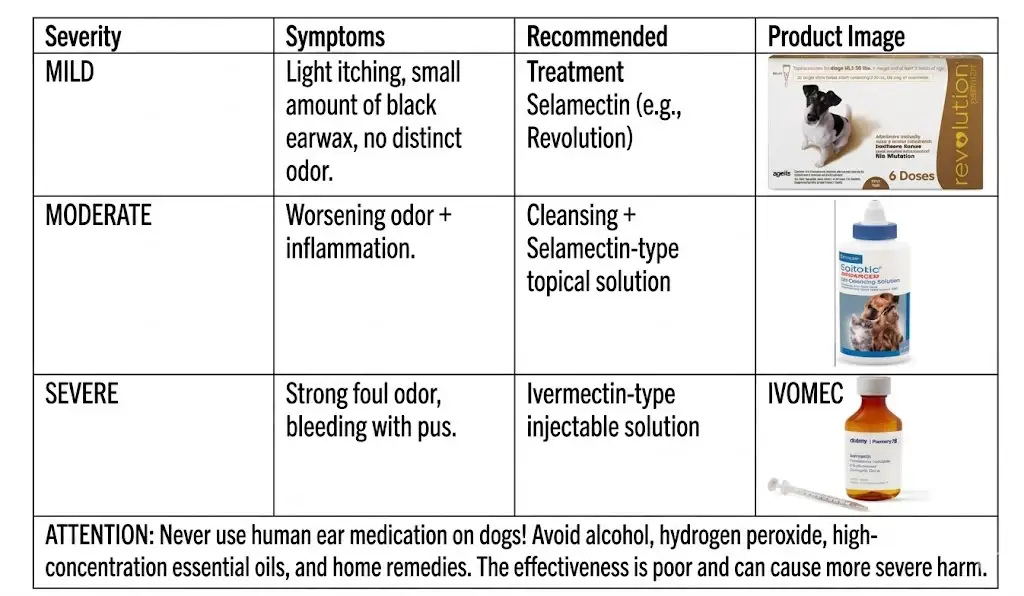
Based on clinical research evidence and veterinary recommendations, the most effective products generally fall into the following three categories; the specific medication chosen should be tailored to the severity of the dog’s ear mite infestation! How can you identify the most effective medication and treatment plan for your specific dog? The vast array of products on the market—including ear washes, drops, and ointments—can often be overwhelming. How do you make the right choice?
Key Ingredients: Selamectin, Moxidectin
Symptoms: Occasional ear scratching, small amounts of black earwax, no distinct foul odor. This indicates an early stage of infection with a low ear mite population; initial symptoms can typically be managed through home care!
Used for the treatment and prevention of ear mites, fleas, heartworms, and certain skin parasites. It offers consistent therapeutic results and serves as a mainstay in modern ear mite treatment protocols. However, please note this medication is not meant to be instilled directly into the ear canal.
It should be applied topically as directed on the product label—specifically, under veterinary guidance. The correct method involves applying the drops to the skin at the back of the neck, where the medication works by being absorbed through the sebaceous glands and into the bloodstream. It is generally recommended for monthly use; avoid bathing the pet for 48 hours before and after application.
Clinical Efficacy: A randomized, blinded, controlled study involving 342 dogs and 237 cats demonstrated significant efficacy. In dogs with ear mites, treatment with Selamectin achieved a cure rate of 90% by Day 60. In cats (across select studies), cure rates ranged from 94% to 100%. Overall safety was excellent, with no treatment-related adverse events observed. Furthermore, relevant FDA data support the use of this veterinary ingredient for parasite control in dogs, and the CAPC guidelines list selamectin (along with certain other topical antiparasitics) as an approved treatment option for ear mites in dogs.
Key Ingredients: Salicylic Acid, Lactic Acid, Chlorhexidine
Symptoms: Frequent head shaking and ear scratching; a marked increase in black earwax; worsening foul odor; and redness, swelling, or inflammation within the ear canal.
At this stage, the ear mite infestation has progressed, causing inflammation within the ear canal. This type of product is designed for direct application into the dog’s ear canal. Fill the ear canal with the cleanser until the liquid overflows, then gently massage the base of the ear for one minute. Release your hands and allow the dog to shake its head naturally. This process helps control the infection; the formula is low-irritation and meets the requirements for most home-based ear care regimens.
It should be noted that ear cleaning solutions primarily serve as an aid for cleaning, rather than being the core method for treating ear mites.
The transmission of ear mites, it can cause ear infections. The things you need to know.
Key Symptoms: Distinct foul odor, presence of pus, pain, and bleeding upon touching the ear.
Highly effective at eradicating ear mites with rapid results. Suitable for adult dogs suffering from severe ear mite infections. However, certain breeds (such as Border Collies, Shetland Sheepdogs, etc.) may carry a genetic mutation that causes sensitivity to ivermectin; for these breeds, injection carries a risk of neurotoxicity. While certain topical ivermectin ear preparations or injection protocols can be effective against ear mites, they must be administered only after a thorough veterinary assessment to avoid endangering the pet’s life!
Ivermectin is an older therapeutic agent that has not been approved by the FDA for this specific use. Currently, there are many FDA-approved selamectin-based products available; pet owners are strongly advised to choose therapeutic medications that are safe and conducive to their pet’s recovery!
This is an experience shared by a pet owner from the Reddit community, helping others make informed decisions when selecting medication for the best ear mite treatment!
Xiaomi is a 4-month-old Bichon Frisé who recently began exhibiting symptoms such as frequent head shaking, ear scratching, and restless nights caused by itching. Upon inspection, the owner discovered dark brown discharge inside Xiaomi’s ear canals, accompanied by a distinct foul odor; consequently, he took Xiaomi to a veterinary clinic for an examination. Using an otoscope, the veterinarian confirmed that it was infected with ear mites and noted mild inflammation within the ear canals. The vet’s first and most critical piece of advice was never to attempt to treat the condition using human-grade ear drops on your own; instead, one must use topical drops specifically formulated for pets in conjunction with a specialized ear-cleaning solution.
The veterinarian prescribed a topical medication containing selamectin—specifically Revolution—dosing it according to Xiaomi’s body weight and also provided a pet-specific ear cleanser. During the first few days of treatment, Xiaomi continued to shake his head occasionally, accompanied by the discharge of black debris; however, the owner diligently maintained the cleaning regimen exactly as instructed by the veterinarian.
Approximately one week later, the frequency of Xiaomi’s ear scratching decreased significantly, and the discharge within the ear canals began to diminish. By the second week, the dark brown discharge had reduced substantially, and the foul odor was no longer noticeable. Crucially, the owner did not discontinue the medication prematurely simply because the symptoms had improved; instead, he continued to follow the prescribed treatment protocol to completion.
After approximately 3 to 4 weeks, Xiaomi’s ears were visibly clean; the head shaking and scratching had virtually ceased, and the redness and swelling within the ear canals had returned to normal. During the follow-up visit, the veterinarian confirmed that the ear mite infestation was under control, while also reminding the owner to continue prioritizing ear hygiene and maintaining a clean home environment to prevent any recurrence of the infection.
The veterinarian emphasized to the owner that, upon discovering ear mites, prompt treatment is essential. Furthermore, achieving the optimal therapeutic outcome requires selecting an appropriate, veterinarian-recommended medication based on the severity of the infection and combining this treatment with consistent ear cleaning and proper environmental management.
The answer is a definitive “yes”—this is possible.
Many pet owners, concerned about high veterinary costs and the inconvenience of outings, wish to resolve their dog’s ear mite issues at home. However, when using medications or treatments, it is crucial to accurately assess the severity of the infestation. For mild to moderate cases of ear mites, a visit to the veterinary clinic may not be necessary; scientific home care methods can effectively control and cure the condition. Conversely, if severe symptoms—such as pus discharge from the ear canal, ulceration, or serious infection—are present, you must seek veterinary help immediately!
In the book published in 2002, Manual of Natural Veterinary Medicine: Science and Tradition, veterinarians Susan G. Wynn and Steve Marsden note that olive oil can be utilized in the treatment of ear mites. Olive oil and coconut oil are among the safest ingredients for home-based ear mite remedies. These oils work by coating the ear mites, thereby cutting off their oxygen supply and effectively suffocating the adult mites. Simultaneously, the oils soften stubborn earwax, making subsequent cleaning of the ear canal easier and helping to prevent bacterial overgrowth.
Instructions:
1. Gently warm a natural oil—such as olive oil or coconut oil—until it is close to your dog’s body temperature. Be careful not to overheat the oil, as this could scald and injure your dog’s ear.
2. Instill 2–3 drops of the oil into your dog’s ear. Gently massage the base of the ear for 1–2 minutes to ensure the oil fully penetrates the ear canal.
3. Allow your dog to shake its head freely; this helps dislodge the softened earwax and dead mites. Afterward, use a sterile cotton ball to carefully clean the ear.
4. It is recommended to perform this procedure once every three days for a period of 2 weeks to achieve the best results.
Apple cider vinegar possesses natural antibacterial and antifungal properties. It helps to balance the pH level within your pet’s ears and improves the overall environment of the ear canal, thereby making it more difficult for ear mites to multiply rapidly or for secondary infections to develop. Additionally, the acetic acid present in the vinegar can slightly dissolve earwax, making subsequent cleaning much easier.
Instructions:
1. Prepare 1 part apple cider vinegar and 1 part distilled water; pour them into a small bowl and mix thoroughly at a 1:1 ratio. Warm the mixture to room temperature to avoid irritating the ear canal with liquid that is either too cold or too hot.
2. Check if the solution’s acidity is too strong; if it feels noticeably irritating, you may add more distilled water to dilute it further. Use a dropper to administer 3–5 drops into each ear. Gently massage the base of the ear for 30–60 seconds to help the solution coat the ear canal and take effect, then allow the dog to shake its head naturally.
3. Use a cotton ball to wipe away any excess liquid from the outside of the ear.
4. Maintain a routine of 1–2 times per week, continuing for 2–3 weeks while monitoring the recovery status of the ear canals.
Home care methods can be useful for softening earwax and aiding in cleaning, but they cannot serve as a substitute for professional veterinary antiparasitic treatment. For suspected cases of ear mites, the preferred course of action remains the use of evidence-backed topical medications prescribed by a veterinarian.
This conclusion is drawn from the shared experiences of numerous dog owners on Reddit.
As previously mentioned, ear mites are highly contagious and spread through the surrounding environment; mite eggs can linger on dog beds, kennels, pet toys, and in the corners of your home. Thorough disinfection is absolutely essential to effectively eradicate the mites! It is often a lack of understanding regarding our dogs that leads to ear mite infestations!
1. Regularly wash pet supplies—or any items the pet comes into contact with—using hot water (above 60°C) and leave them to sunbathe for at least 4 hours to destroy any potential mite eggs. When my dog had ear mites before, the first thing I did was clean all of my pet’s belongings. I believe many Reddit users have gone through the same experience as I!
2. Isolate the dog suffering from ear mites from other pets to prevent cross-infection among cats, dogs, or other animals in the household.
3. Clean the dog’s ear canals daily using a specialized ear-cleaning solution designed for dogs, and ensure the ears remain dry to prevent mites from breeding again.
If you want to learn more about pets, please visit vilipets.com.
No, ear mites are easily transmitted between pets, but they do not infect humans. If ear mites are not parasitizing an animal, they will die quickly.
No, ear mites in dogs will not go away on their own. These parasites multiply continuously and are highly contagious; without timely treatment, the infection will only worsen over time, potentially leading to severe fungal or yeast infections and even impairing the dog’s hearing. Therefore, please seek veterinary care promptly if you discover an ear mite infestation.
Mild ear mites are usually painless, but they can be extremely itchy, causing dogs to scratch their ears frequently, breaking the skin in the ear canal and leading to bleeding. This can then result in fungal infection, ear swelling, and in severe cases, pain. Typically, one ear is initially infected, and the mites spread to the other ear through scratching.