
You’ve probably seen the memes—a bug-eyed, shivering little dog paired with captions like “Small but Spiteful” or “The Evil Chihuahua.” Social media is flooded with “Demon Chihuahua” content, successfully painting this breed as the ultimate hothead of the canine world.
But my curiosity stems from a real-life dynamic I observe at the dog park. I own an 8-year-old Corgi named Yutou (Taro). He outweighs a Chihuahua by several magnitudes and carries himself with a calm, sturdy demeanor. Yet, bizarrely, whenever we visit the dog park, it’s always Yutou who gets snarled at and fiercely warned off by Chihuahuas that barely tip the scales at four pounds. Despite the massive size disparity, the tiny Chihuahuas consistently dominate the psychological turf. This dramatic contrast got me thinking: Why are Chihuahuas so aggressive? Is this hyper-reactivity a hardwired genetic blueprint, or is it a behavioral byproduct of being pampered by their owners?
In this article, we will break down the mechanics behind a Chihuahua’s fiery temperament through four distinct lenses: evolutionary history, underlying health variables, territorial instincts and—perhaps most importantly—human behavior.
Table of Contents
Are Chihuahuas Actually the Most Aggressive Dog Breed?
Yes, studies show Chihuahuas report higher rates of low-level aggression (like growling and snapping) than many breeds. However, they are “moderately aggressive” at most, and their behavior is rarely dangerous.
A large-scale survey involving over 4,000 dog owners revealed that out of 35 breeds studied, the Chihuahua was rated as the most aggressive—even surpassing the American Pit Bull Terrier. They are particularly prone to directing hostility toward unfamiliar, larger dogs.
However, a critical caveat remains: not a single breed in the study was classified as “highly aggressive overall.” The Chihuahua, at most, achieved a rating of “moderately aggressive” on certain metrics, falling into the “sometimes exhibits aggressive behavior” category the majority of the time. In contrast, other breeds—such as Pugs, Collies, and Cavalier King Charles Spaniels—were predominantly rated as “rarely” or “never” aggressive.
4 Core Reasons Why Chihuahuas Are So Aggressive
1. Genetics and Evolutionary Heritage
To understand the core temperament of a Chihuahua, one must first flip through its evolutionary textbook.
Originating in Mexico, the Chihuahua descends from the Techichi—a companion and ritual dog kept by ancient Toltec and Aztec civilizations. Unlike modern Chihuahuas, the Techichi was larger and occasionally utilized as a food source. This severe environmental pressure over centuries has selectively bred for heightened vigilance and defensive behaviors. Through selective breeding over hundreds of years, the physical stature of the Chihuahua dramatically diminished, yet its psychological profile remained intact—resolute, alert, and hyper-sensitive to novel stimuli. However, a critical psychological fact often gets overlooked: they are acutely aware of their own size.
In evolutionary biology, there is a fundamental baseline logic: the smaller an animal is, the more it must rely on “bluffing” to compensate for its structural vulnerabilities. In a wild or unpredictable ecosystem, a four-pound animal encountering an adversary multiple times its size cannot realistically rely on flight. Its primary survival mechanism is to preemptively strike—deploying the fiercest vocalizations and the most exaggerated posturing to deter the perceived threat before it advances.
A comprehensive study from the University of Helsinki corroborates this mechanical link. Researchers explicitly noted that canine aggression directed toward humans is frequently driven by fear, establishing a robust correlation between fearfulness and aggressive behavior. The study further highlighted that while variance across breeds reflects underlying genetic components, aggression cannot be simplistically attributed to breed alone. Environmental variables, the quality of early-stage socialization, and an individual dog’s subjective sense of safety consistently outweigh raw genetics. This explains why a Chihuahua’s “aggression” is fundamentally a survival instinct rather than a character flaw.
2. Hidden Dental Pain and Compact Jaw Anatomy
If your Chihuahua suddenly becomes prone to biting or shows a sharp spike in irritability, hold off on labeling it a “behavioral issue”—it is time to examine their oral cavity.
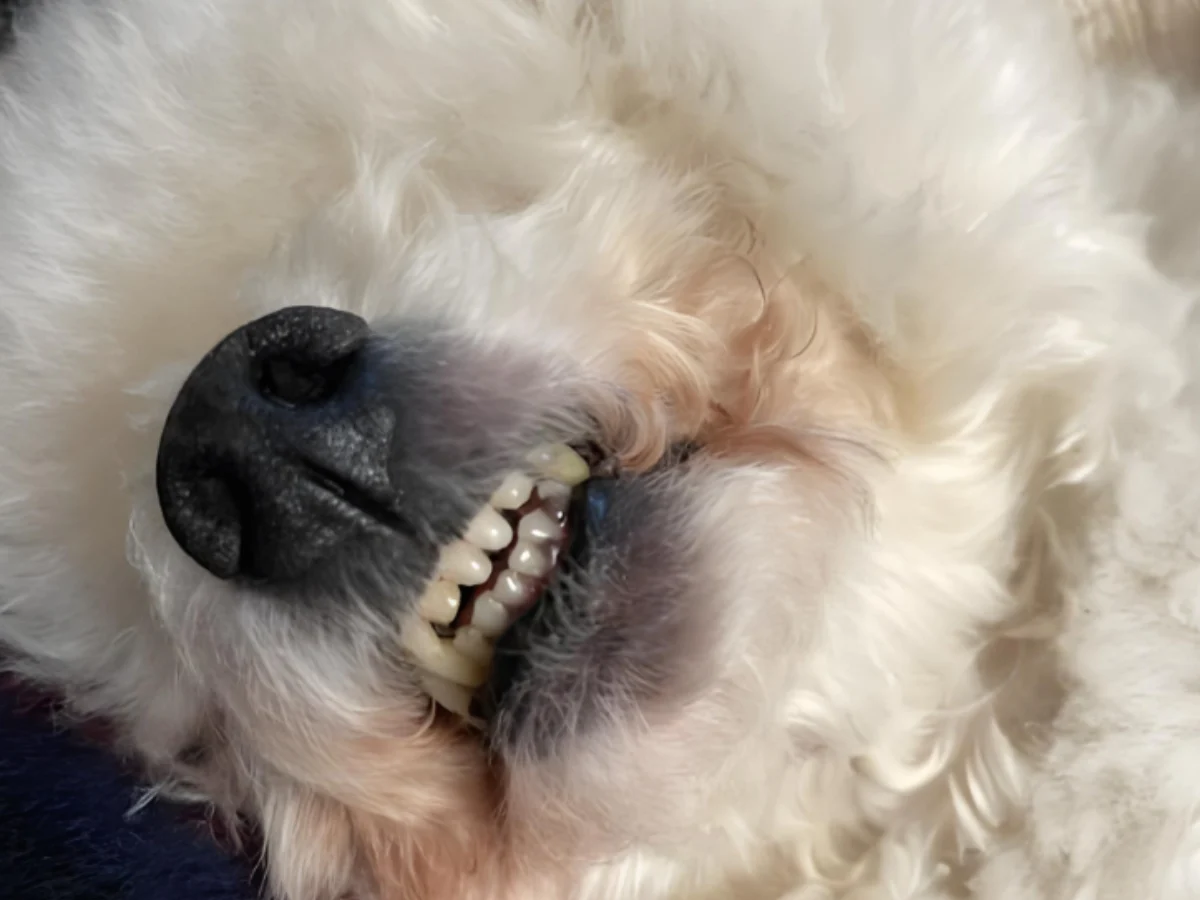
The fundamental anatomical reality is that a Chihuahua’s upper and lower jawbones are simply too compact to comfortably accommodate a standard set of 42 adult canine teeth. Forcing a full set of teeth into a jaw cavity roughly the size of a golf ball leads to severe dental crowding. This structural misalignment creates dense plaque traps where food debris accumulates, leading to rapid calculus formation, moving on to gingivitis and advanced periodontal disease.
This is far from a minor cosmetic concern. Data from the Royal Veterinary College’s VetCompass programme indicates that dental disease carries the highest clinically recorded prevalence among all disorders diagnosed in Chihuahuas. Globally, veterinary research demonstrates that 80% to 89% of dogs over the age of three suffer from some degree of periodontal disease, with toy and brachycephalic miniature breeds exhibiting the highest vulnerability. Consequently, a significant portion of a Chihuahua’s snapping or biting behavior is actually a manifestation of chronic oral pain—driven by inflamed gingiva, loose tooth roots, or active alveolar bone loss.
When an owner reaches out to pet the dog’s head and inadvertently applies pressure near the muzzle, the dog may snap as a reflexive, pain-induced defense mechanism. While human observers often misinterpret this as “unprovoked aggression,” it is fundamentally a localized pain response from an unbearable oral infection.
Note: Periodontal disease does not remain localized within the mouth. Pathogenic oral bacteria can easily breach the compromised gingival barrier, entering the bloodstream (bacteremia), where they risk colonizing heart valves, potentially leading to endocarditis. Furthermore, this chronic, low-grade systemic infection places a continuous metabolic burden on the filtration systems of both the kidneys and the liver. Therefore, regular professional dog teeth cleanings—essential for Chihuahuas and all toy breeds alike—are not an overreaction; it is critical preventative healthcare.
3. Lack of Socialization and “Small Dog Syndrome”
Empirical research continuously demonstrates that canine behavior is the dynamic byproduct of both genetics and environmental variables. A landmark 2026 genomic study published in Science revealed that a dog’s breed accounts for a mere 9% of individual behavioral variations. Concurrently, data analyzed by researchers at the Broad Institute across 4,497 dogs indicated that adverse experiences during the critical first six months of a puppy’s life are significantly correlated with elevated levels of fear and aggression in adulthood.
Experts at Dogster further corroborate this, noting that a Chihuahua’s reactive behavior is largely detached from its genetic lineage. Instead, it is heavily moderated by its socialization history, learning experiences, environment, and individual temperament. To put it bluntly, their infamous “bad temper” is predominantly a behavioral construct shaped by human rearing practices.
4. Territorial Instincts and Resource Guarding
Chihuahuas possess an innate, heightened possessiveness over their environment, toys, food, and preferred humans. This often manifests as territorial or resource-guarding aggression. While common across all canine breeds, this reactive behavior is severely amplified in Chihuahuas due to their hyper-attachment to their owners.
Whether it is a favorite toy, a prime resting spot, a high-value treat, or their primary handler, Chihuahuas will instinctively defend these assets. If they perceive a threat to their resources, they will immediately deploy aggressive displays as a defensive strategy.
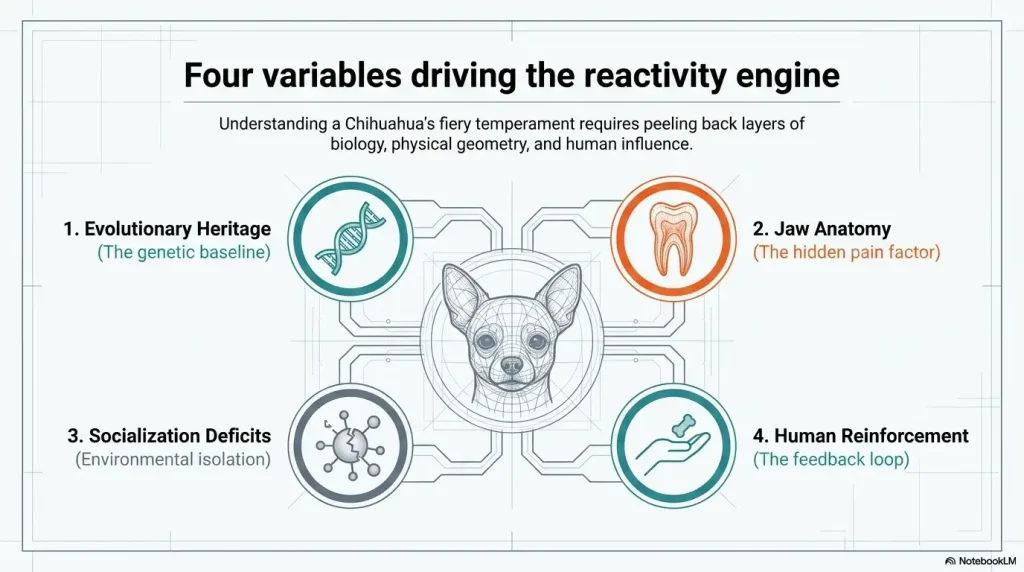
I made a summary chart here to clarify things for you:
Three Most Prevalent Mistakes Owners Commit
1. The “Too Small to Train“ Fallacy
Because of the Chihuahua’s diminutive physical stature, many owners operate under the false assumption that formal obedience training is unnecessary.
When an undesirable behavior manifests, the default response is often to physically scoop the dog up and remove it from the situation, leading owners to tolerate or ignore boundary-pushing behaviors. Consequently, these dogs fail to develop emotional regulation, gradually establishing a habit of hyperreactivity when introduced to novel environments.
Ironically, Chihuahuas are highly intelligent and quick learners. They respond exceptionally well to positive reinforcement and food-reward-based training modalities. What they truly require is the exact same structured training framework typically reserved for large-breed dogs.
2. Misinterpreting Aggressive Signals as Loyalty or Affection
When a Chihuahua lunges or barks at a stranger, owners frequently romanticize the behavior as “protective instincts.” When it growls at a larger dog, it is often dismissed as “having a brave spirit.” In either scenario, the human response typically involves laughter, intense eye contact, or soothing physical touch. To the canine mind, this immediate sensory feedback serves as a potent form of positive reinforcement. The dog remains oblivious to the human concepts of “loyalty” or “courage”; it simply registers that its reactive display yielded a high-value reward: parental attention.
This dynamic is a primary catalyst for Small Dog Syndrome, characterized by chronic growling, snapping, and severe resource guarding. From a behavioral perspective, this is rarely “intrinsic malice.” Rather, it is a learned distance-increasing mechanism deployed by an anxious or stressed dog. If the owner consistently retreats or removes the stressor following these displays, the maladaptive behavior becomes systematically reinforced.
3. Overprotection and Social Isolation
Comprehensive, early-life socialization remains one of the most effective preventative strategies for mitigating fear and reducing the statistical risk of aggression. Regrettably, because many owners perceive the Chihuahua as physically “harmless,” they completely bypass this developmental milestone. This explains the high incidence of environmental reactivity displayed by Chihuahuas in public spaces—they have simply never been systematically introduced to the macro-world.
Chihuahuas are not genetically predestined to be inherently belligerent or hostile. They are dogs—simply scaled down in physical architecture—and like any other canine breed, they require clear boundaries, structural training, and robust socialization. Fulfilling that developmental need is fundamentally a human responsibility.
How to Stop Chihuahuas From Being So Aggressive
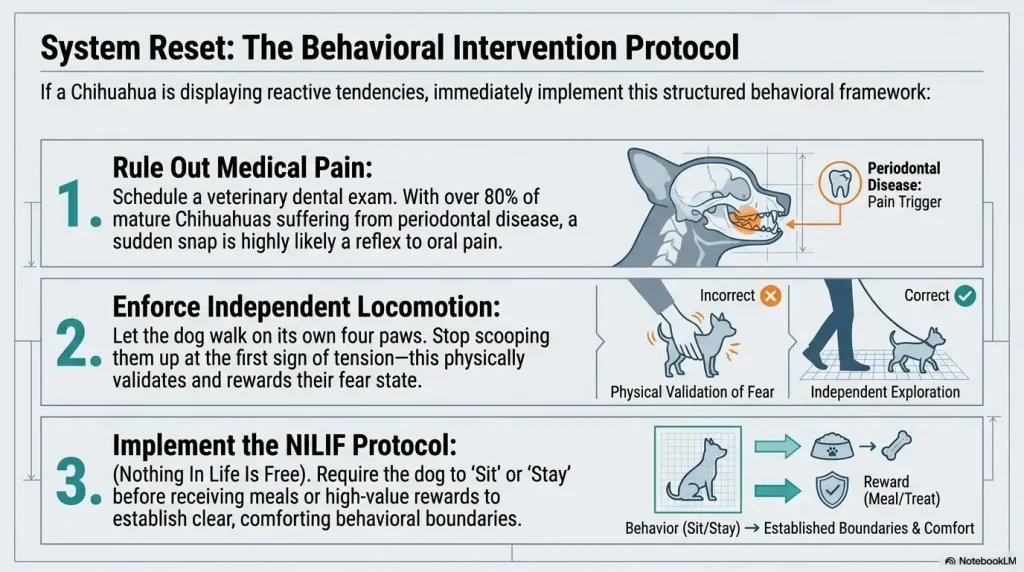
If your Chihuahua is currently displaying reactive or aggressive tendencies, the following is a structured, step-by-step behavioral intervention protocol:
Step 1: Rule Out Medical Pain
Schedule a vet checkup immediately. With over 80% of Chihuahuas over age three suffering from painful periodontal disease, that sudden snap might just be a reflex to chronic oral pain.
Step 2: Enforce Independent Locomotion
Let your dog walk on its own four paws. Stop scooping them up into your arms at the first sign of tension —this only validates and rewards their fear.
Step 3: Implement the NILIF(Nothing in Life is Free) Protocol
Make your dog “Sit” or “Stay” before receiving meals or high-value rewards to establish clear behavioral boundaries.
Conclusion
A Chihuahua’s reactivity is rarely random; it is the cumulative result of fear, socialization deficits, chronic dental pain, and inadvertent owner reinforcement. Ultimately, a dog’s behavior mirrors the training and boundaries provided by its handler.
Veterinary Disclaimer
Disclaimer: This article is for informational purposes only and does not substitute for professional veterinary or behavioral advice. For concerning canine aggression, please consult a licensed veterinarian or a certified behaviorist (CAAB/IAABC) for a tailored intervention plan.
-
Sale!

Gentle Neutral pH Round Pet Eye Wipes Tear Stain Removal
Original price was: $5.98.$2.99Current price is: $2.99. Add to cart -
Sale!

Gentle Pet Ear Drops for Dogs Cats Ear Care & Wax Removal
Original price was: $6.19.$5.99Current price is: $5.99. Add to cart -
Sale!
-1-300x300.webp)
Large Green Pet Dental Wipes Teeth Cleaning amp Fresh Breath
Original price was: $5.99.$3.99Current price is: $3.99. Read more