
As a long-time dog owner and blogger, I know firsthand that one of the most terrifying things for a pet parent to witness is their vibrant, happy-go-lucky pup suddenly refusing their favorite hard treats or waking up with a mysterious, alarming swelling right beneath their eye. Years ago, my own Golden Retriever went through this exact ordeal when he was seven years old. At the time, I foolishly assumed he had either been stung by a bee or was suffering from a mild eye infection. It wasn’t until our veterinarian diagnosed it as a classic carnassial tooth root abscess (the upper fourth premolar) that I realized how close I had come to letting my ignorance delay his vital treatment.
Dental issues in dogs are truly “silent killers”. Today, combining clinical veterinary dental standards—such as the guidelines set by the American Veterinary Dental College (AVDC)—with my years of hands-on pet parenting experience, I am going to break down everything you need to know about dog tooth abscesses.
Simply put, a dog tooth abscess is a localized, severe, deep-seated bacterial infection. When bacteria manage to invade the inner dental pulp—either through a fractured tooth surface, microscopic enamel cracks, or deep periodontal pockets caused by advanced gum disease—they find a warm, oxygen-deprived environment where they can multiply rapidly.
As the infection worsens, dead tissue and active bacteria pool at the very tip of the tooth root, forming a localized pocket of pus. Because the surrounding alveolar bone cannot expand, pressure builds up intensely. The abscess eventually forces its way outward along the path of least resistance, which typically manifests as sudden, dramatic swelling on the dog’s face, beneath the eye, or inside the oral cavity.
Dogs are evolutionary masters at masking their pain. By the time you notice an obvious physical abnormality, the underlying infection is usually already quite advanced.
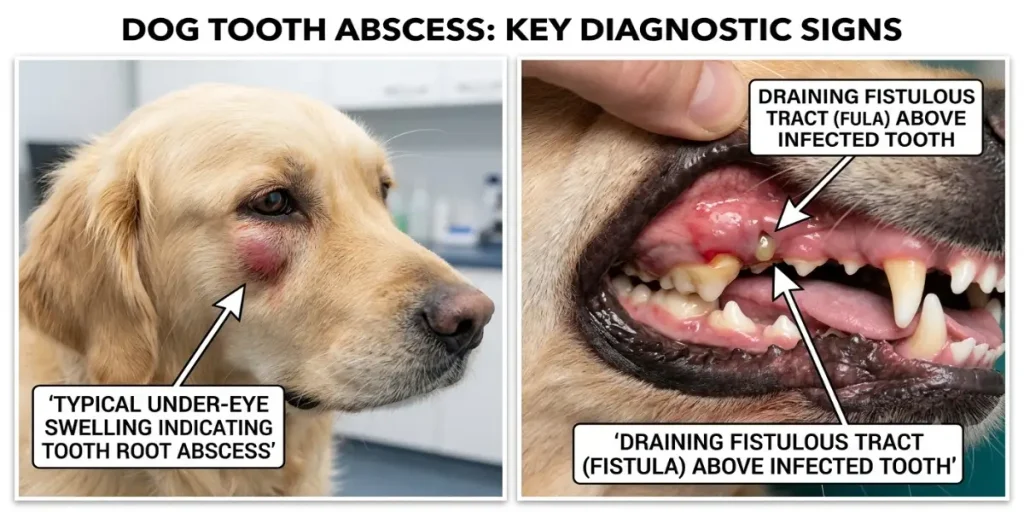
Take a look at the diagnostic reference image below. Note the contrast between the classic under-eye swelling on the left and the active intraoral draining fistulous tract on the right. If your dog exhibits either of these signs, it is time to consult a professional.
Because facial swelling often appears close to the eye, you may also find our guide on how to clean a dog’s eyes safely helpful for keeping the surrounding area clean while you wait for veterinary care.
When pet parents first notice a lump on their dog’s face, many panic and fear the worst—an oral tumor. According to the standard guidelines of the American Veterinary Dental College (AVDC), intraoral dental X-rays under anesthesia are the only definitive way to distinguish between an abscess and a tumor. However, you can make a preliminary scientific assessment using the comparative features below:
| Feature | Dog Tooth Abscess | Oral Tumor |
| Onset & Progression Rate | Extremely rapid; swelling can appear suddenly within 24 to 48 hours. | Relatively slow, gradual, and progressive growth over weeks or months. |
| Feel & Pain Level | Intensely painful to the touch; the swelling may feel warm and fluctuant (fluid-filled). | Typically firm or hard; the dog may show no obvious pain in the early stages. |
| Dental X-ray Findings | Shows a distinct radiolucent halo (dark area indicating bone loss) localized around the tooth root. | Displays widespread bone destruction or abnormal, irregular tissue proliferation. |
| Response to Antibiotics | Temporary reduction in swelling and localized inflammation. | Absolutely no response or change in size with antibiotics. |
The short answer is absolutely not. A tooth abscess is not a static cosmetic blemish; it is an active, highly painful, and destructive bacterial infection. Just because your dog’s survival instinct drives them to keep eating does not mean they are comfortable. Leaving this untreated subjects your pet to chronic, debilitating pain, constant systemic stress, a weakened immune system, and a severe drop in their overall quality of life.
While a tooth root abscess rarely causes sudden death within a matter of days, it is absolutely fatal if left completely untreated over time.
The bacteria localized at the root tip (often highly destructive anaerobes) will gradually eat away at the jawbone and eventually breach the rich network of facial blood vessels. This allows bacteria to enter the general bloodstream, leading to life-threatening sepsis. According to clinical studies published in the Journal of the American Veterinary Medical Association (JAVMA), untreated chronic dental infections can lead to hematogenous bacterial spread, seeding infection directly into the heart (causing endocarditis), kidneys, and liver. This systemic degradation can result in irreversible multi-organ failure over the course of weeks or months.
Yes, many canine tooth abscesses will eventually rupture on their own. As pus continues to accumulate, the skin directly over the swelling thins and tears, typically resulting in a mixture of blood and pus draining down the dog’s face just below the eye.
Blogger’s Warning (Avoid This Trap):
When an abscess ruptures, the facial swelling often rapidly subsides, and the dog may suddenly seem much happier. Do not fall into the trap of thinking the infection has “healed itself”! The rupture merely released the painful physical pressure on the local nerves. As long as the dead, infected tooth remains in the socket, the bacterial source is still alive, and the dog tooth abscess is guaranteed to recur within a few weeks.
If you search online for “dog tooth infection home treatment,” you will likely find endless DIY blogs recommending coconut oil, herbal poultices, or human painkillers. As a pet professional, I must warn you: no home remedy can cure a canine tooth root abscess. Attempting to treat this at home only prolongs your pet’s suffering and risks fatal toxicity (e.g., human NSAIDs and acetaminophen are highly toxic to dogs).
When your vet prescribes antibiotics like Clindamycin or Amoxicillin-Clavulanate, do not assume the pills alone will fix the problem. Antibiotics are strictly a temporary supportive measure. They can travel through the bloodstream to clear up the infection in the surrounding soft tissues and temporarily bring down the facial swelling. However, because the inner pulp of the diseased tooth is dead and devoid of blood flow, antibiotics cannot penetrate the inside of the tooth to kill the bacterial reservoir. The moment you stop the medication, the bacteria hiding inside the tooth root will march right back out.
To permanently resolve the infection, the dog must undergo general anesthesia for one of two dental procedures:
On Reddit veterinary boards (such as r/AskVet or r/dogs), one of the most frequently discussed topics is the sheer cost of treating dental issues. To help you budget and avoid surprise bills, here is a standard breakdown of typical veterinary dental surgical costs in North America:
| Veterinary Service / Dental Procedure | Estimated Cost Range (USD) | Clinical Necessity |
| Pre-anesthetic Blood Work | $100 – $200 | Evaluates liver and kidney function to ensure your dog can safely metabolize the anesthetic drugs (crucial for senior dogs). |
| Inhalation Anesthesia & Full Monitoring | $200 – $400 | Safe general anesthesia is the absolute foundation of any complex oral surgery. |
| Digital Dental X-rays (Pre- & Post-op) | $150 – $300 | Evaluates the full extent of root bone loss and guarantees no hidden root fragments are left behind (an AVDC requirement). |
| Surgical Extraction (Depending on root count) | $150 – $600 (per tooth) | Large, multi-rooted chewing teeth require surgical gum flaps, sectioning with high-speed drills, and precise suturing. |
| Post-op Take-Home Medications | $50 – $120 | Includes antibiotics and veterinary-safe anti-inflammatories to ensure your dog is pain-free and comfortable during recovery. |
| Total Estimated Cost | $650 – $1,600+ | Note: These figures are based on standard veterinary clinics in North America and major metropolitan areas. Prices vary widely depending on geography, clinic specialty, dog size, and case complexity. |
Rather than paying a steep price after your dog has already suffered, prevention is always the better option. Following a complete dog dental care routine—including daily brushing, professional cleanings, and plaque prevention—can dramatically reduce the risk of tooth abscesses. Here are the gold-standard preventative tips recommended by top veterinary dental specialists:
No, antibiotics alone cannot cure a dog’s tooth root abscess. While antibiotics like clindamycin can temporarily reduce swelling and kill surrounding bacteria, they cannot penetrate the dead pulp inside the tooth root. The infection will always return once the medication is stopped. Permanent cure requires tooth extraction or a root canal performed by a vet.
A dog tooth abscess typically presents as a sudden, painful swelling on one side of the face, often just below the eye (especially if the carnassial tooth is infected). Inside the mouth, you may see red, inflamed gums, a draining bump (fistula) oozing pus or blood, and the dog may show extreme sensitivity or pain when the area is touched.
You cannot safely or effectively treat a dog’s tooth infection at home without a vet. Home remedies (like herbal poultices or human painkillers) are highly dangerous and will not cure the underlying infection. The only safe home care is palliative support—such as offering soft food and applying a warm compress—while you wait for your scheduled veterinary appointment.
A dog tooth abscess is far more than just a bad tooth; it is an incredibly painful, active infection that compromises your dog’s everyday comfort, eating habits, and systemic health.
If there is one thing every pet parent should take away, it is this:
Prevention is always easier, cheaper, and infinitely kinder than treating advanced dental disease. By brushing their teeth daily, choosing safe chew toys, and maintaining regular veterinary dental checkups, you can ensure your dog keeps their happy, healthy smile for a lifetime.
The information provided in this article is strictly for educational and informational purposes and should never replace professional veterinary advice, diagnosis, or treatment. Every dog is unique, and dental conditions can vary significantly based on your pet’s age, breed, medical history, and specific circumstances. If you suspect your dog has a tooth abscess or is exhibiting signs like facial swelling, difficulty eating, or abnormal drooling, please consult a licensed veterinarian immediately. Never administer human medications, painkillers, or antibiotics to your dog unless explicitly directed to do so by a veterinary professional.