
As a new pet parent, have you recently found yourself wondering if that adorable, fluffy puppy you brought home has secretly turned into a “walking paper shredder”? Are your jeans, slippers, and even the edges of your sofa covered in tiny puncture marks? Don’t worry—this isn’t intentional mischief; your pup is simply going through a crucial developmental milestone: the teething phase.
To help both you and your furry friend navigate this period smoothly, let’s start by answering the question that’s likely puzzling you the most: exactly when do puppies start losing their baby teeth? If you are anxious about when do puppy teeth fall out or how to soothe their bleeding gums, this vet-backed guide has you covered
Backed by the latest veterinary and pet care standards, this comprehensive guide will walk you through the complete timeline of puppy teething and provide a guide to proper care.
To help you clearly track your puppy’s teething progress, here is a month-by-month developmental timeline based on scientific insights.
Based on scientific veterinary standards, the active puppy teething phase typically lasts for about 4 months in total. Here is the exact breakdown:
Data source: AVDC (American Veterinary Dental College) guidelines on the standard timeline for canine dental development.
| Developmental stage | Age milestones | Oral physiological characteristics and the sequence of tooth exfoliation/eruption | Typical behavioral manifestations |
| Early stage | 3–4 months | The incisors begin to fall out, and the permanent incisors begin to erupt. | The gums are slightly red and swollen, and the front teeth begin to be licked frequently |
| The Peak Phase | 4-5 months | The premolars and the iconic canines begin to fall out in large numbers. | Do puppies lose teeth at 5 months? Absolutely. This is the absolute peak of teething discomfort, where the urge to chew everything in sight goes into overdrive to soothe itchy, aching gums. |
| Final stage | 6-7 months | All deciduous teeth have been shed, and the molars at the back have fully erupted, resulting in a total of 42 permanent teeth. | Chewing and biting behaviors gradually taper off, while overall bite force increases significantly as the jaw matures. |
Many new pet parents wonder about the mechanics of the teething process—specifically, when and how often puppies lose their baby teeth. Understanding your pup’s mouth anatomy helps you know exactly what to expect:
Puppy Teeth Aging Tip: You can use this oral anatomy as a natural clock. By observing whether your pup is shedding incisors (3-4 months) or cutting molars (6-7 months), you can accurately estimate your dog’s current developmental stage.
Between 4 and 6 months of age, both primary (baby) and permanent adult teeth may be present in the mouth simultaneously. This is a normal physiological transition period.
If a baby tooth does not fall out when its permanent counterpart erupts, they will sit directly next to each other. The American Veterinary Dental College (AVDC) strongly recommends its extraction as soon as possible.
Sharing a personal experience: When my dog Luna was four and a half months old,coming home from work felt like an absolute treasure hunt. I once found two of her baby canine teeth lying side-by-side on one of her plush toys. That was also the time she was at her grumpiest; she even gnawed marks into the wooden legs of our furniture. If your dog is currently at this age, please make sure to provide plenty of durable chew toys—this is the peak of the teething phase, when their gums are at their most uncomfortable!
If your puppy starts losing teeth and you aren’t sure if it is a normal part of the process, the following four typical physical signs can help you identify what is happening.
Gum abnormalities: During the teething phase, you may notice your dog’s gums are slightly red, swollen, and sensitive; there may even be minor bleeding as baby teeth are on the verge of falling out.
Increased drooling and temporary bad breath: Puppies often drool frequently while teething. As baby teeth loosen, mild oral inflammation may occur; the mixture of small amounts of blood, saliva, and food debris can create an unpleasant mouth odor resembling rust or a fishy smell.
When your dog is going through the teething stage, you—as their human—should adopt scientifically sound and effective methods to alleviate their pain and anxiety; doing so not only strengthens the bond of trust between you and your dog but also helps prevent potential oral health issues.
As permanent teeth push through the gums, localized redness, swelling, and throbbing pain are completely normal. Dietary adjustments and physical relief methods can significantly alleviate the associated discomfort.
When a dog frequently chews on household items, the best approach is not simply to stop the behavior, but to teach the dog exactly what it *should* be chewing.
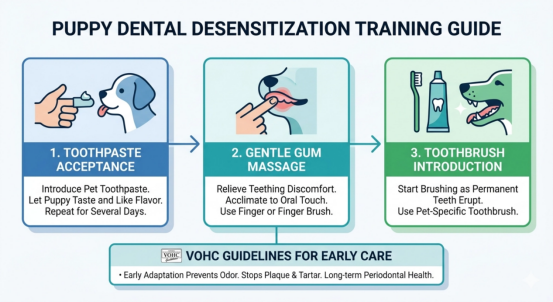
Many pet parents mistakenly believe that since puppy teeth will eventually fall out, there is no rush to start brushing until the permanent teeth have come in. This is a major misconception.
Early Intervention: The period between 3 and 5 months of age is the prime time for puppies to accept new experiences and establish daily care routines. Getting them accustomed to having objects placed in their mouths during this stage makes future care much easier and more effective.
How to desensitize your pup in 3 steps:
Industry guidelines from the VOHC (Veterinary Oral Health Council) regarding early-stage canine plaque prevention, training for toothbrushing tolerance, and long-term oral care state: “Acclimating puppies to oral cleaning as early as possible not only effectively eliminates odors caused by drooling and bleeding during the teething phase but also effectively prevents the future development of tartar and periodontal disease.”
You should schedule an appointment with a local veterinary clinic if your puppy experiences the following during the teething period:
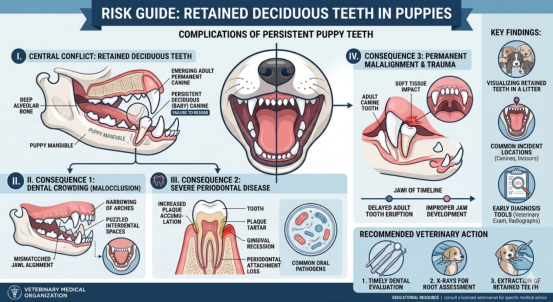
When a permanent tooth has erupted but the corresponding baby tooth fails to fall out, the condition is medically known as retained deciduous teeth.
Normally, as a permanent tooth erupts, it exerts pressure on the root of the baby tooth, causing it to be naturally resorbed and shed. If this process fails, both teeth remain side-by-side. This can lead to serious oral health issues:
Data from studies published in the Journal of the American Veterinary Medical Association (JAVMA) indicate the following:
In clinical practice, small- and medium-sized breeds (such as Poodles, Yorkshire Terriers, and Pomeranians) and brachycephalic breeds exhibit a significantly higher incidence of retained deciduous teeth compared to large breeds. Research suggests that this condition often has a genetic basis and most frequently affects the canine teeth.
In addition to retained baby teeth, if your puppy exhibits the following symptoms while teething, do not dismiss them as normal teething reactions; contact a veterinarian immediately:
Yes, puppies frequently swallow their baby teeth, usually while eating food or playing with their toys. You don’t need to panic—this is completely safe and normal. A puppy’s digestive system can naturally pass these tiny teeth without any harm or internal injury.
Absolutely! The period between 4 to 5 months of age is the absolute peak of the teething phase. During this stage, their sharp canine teeth and premolars fall out in large numbers, which triggers an intense urge to chew everything in sight to soothe aching gums.
If your puppy is 6 to 7 months old and you still notice a small, sharp baby tooth sitting directly adjacent to a newly erupted adult tooth (often called “double teeth”), it is likely a retained deciduous tooth. You should consult your vet, as small breeds like Poodles or Yorkies are highly prone to this, and it may require extraction under anesthesia to prevent gum disease.
All content provided on this website/blog (including, but not limited to, articles, charts, comments, and replies) is intended solely for informational, educational, and experience-sharing purposes; it does not constitute professional veterinary diagnosis, treatment advice, or medical prescriptions.
Every pet has a unique physical condition, breed characteristics, and health history. Although the authors possess extensive experience in pet nutrition and care, online information cannot replace an in-person clinical veterinary examination. Please consult a licensed veterinarian (DVM) for professional advice before making any changes to your pet’s diet or training regimen, or before undertaking any medical care based on the content of this site.